Automating customer service: which requests AI solves in 2026
Find out which support requests AI reliably automates in 2026 and where bots fail. A practical guide for SaaS and e-commerce, without the hype.
Martin Semmele
Key insights
- 88 per cent of the businesses that use AI use it in customer contact.
- In e-commerce, up to 70 per cent of standard requests such as returns can be resolved automatically.
- Complex problems require human expertise: only 12 per cent of difficult orders run autonomously.
- AI must not guess: an internal, well-maintained knowledge base is the basic requirement.
- A firm handover process from the AI to the support team prevents frustration for customers.
The reality of AI automation in 2026
Artificial intelligence has long been part of everyday customer service. A survey by the industry association Bitkom shows that 88 per cent of the businesses that use AI already use it in customer contact1. But the number of systems in use says little about how efficient they actually are. In practice there is a gap between theoretical expectations and the operational reality in support teams.
The decisive difference lies between mere case deflection and genuine problem-solving. Classic deflection blocks requests, points to static help pages or fobs customers off with generic blocks of text. In the short term that lowers the ticket volume in the inbox, but it often leads to frustration and repeat contacts. Genuine problem-solving, by contrast, answers specific questions directly, precisely and on the basis of verified company data.
| Criterion | Classic case deflection | Genuine AI problem-solving |
|---|---|---|
| Goal | Reduce ticket volume artificially | Resolve the customer's concern at first contact |
| Data basis | Predefined keywords and keyword matching | Structured internal knowledge base |
| Result | Link to a generic FAQ page | Specific answer backed by a source |
| Effect on support | The request is delayed | Genuine relief for the team |
For support managers in B2B SaaS and e-commerce, 2026 is no longer about whether AI is used, but about where it delivers reliable results. Anyone who forces automation without a clean knowledge base creates work somewhere else.
The sweet spot for SaaS: fully solvable requests
Recurring patterns emerge in B2B SaaS businesses. A large share of the daily requests concerns Tier 1 topics: how features work, onboarding steps or billing questions. Such requests are very well suited to full automation, because the answers are clearly defined in manuals, help articles and system documentation.
Studies show that on structured routine requests, modern AI systems can answer more than 80 per cent of all customer questions without human intervention2. The prerequisite is a strict link to internal product knowledge. The AI must not search the internet freely for answers; it must access approved documents only.
- Onboarding steps: explanations of the initial setup, the interface configuration and assigning permissions.
- Feature documentation: instructions for using specific functions in the product.
- Invoice questions: information on billing cycles, payment methods and downloading PDF receipts.
When users want to know where to find their monthly invoice or how an API key is generated, the AI delivers the exact instructions within seconds. The team is freed from monotonous typing and keeps its head clear for complex special cases.
E-commerce focus: scaling standard processes
In online retail, support volume arises above all from logistical standard questions. Requests about delivery status, return periods or the conditions for sending goods back make up a large share of the daily inbox. These processes follow fixed rules and therefore scale very well.
Analyses of e-commerce support data show that AI systems in online shops can handle 60 to 80 per cent of all incoming standard requests automatically3. Vendor reports from shop support describe the same shape: the AI takes over repetitive Tier 1 questions on delivery status (WISMO), refunds and shipment tracking by being connected to shop and helpdesk data as well as to the help documents, and it escalates anything it is unsure about to the team4.
| Type of request | Degree of automation | Prerequisite in the background |
|---|---|---|
| Delivery status (WISMO) | 60 to 80 per cent of the manual WISMO tickets no longer arise | Connection to the shipping provider or ERP |
| Return policies | 65 to 80 per cent of the return requests | Up-to-date documentation of the return conditions |
| Product availability | Within the 60 to 80 per cent of standard requests that AI takes over in shop support | Synchronisation with the inventory management system |
| Copy of an invoice | Largely automatable, because the process is clearly documented and rule-based | Access to the customer account and the receipt archive |
In e-commerce, buyers expect immediate orientation. An AI system that states return periods or reports the status of a shipment precisely solves the problem right at first contact. That cuts waiting times for customers to a few seconds.
The limits: where AI automation fails
As capable as modern AI models are at routine tasks, their limits are just as clear. Automation runs into its barriers wherever individual discretion, deep technical fault analysis or human empathy is called for. Anyone who tries to hand such cases over to an AI entirely risks losing customers and damaging their reputation.
A trend study by Esker illustrates the attitude inside businesses: two thirds of all respondents use at least partly automated processes, but only 12 per cent process complex orders fully autonomously7. That underlines that the human factor remains indispensable in service.
- Complex fault analysis: finding the cause of individual system errors or damaged goods.
- Emotional escalations: complaints from angry customers that call for sensitivity and goodwill decisions.
- Novel problems: edge cases and software bugs that are not yet documented in any knowledge base.
As soon as a request departs from the predefined standard paths, the system has to recognise the limit. A failed attempt at automation, in which the customer is stuck in an endless loop, creates far more frustration than a short wait for a human team member.
The architecture requirement: no solution without knowledge
The technical foundation of every reliable AI automation is a clean knowledge architecture. Freely generating language models tend to fill missing information with plausible but false inventions. In customer service such hallucinations are unacceptable, because they lead to false statements about prices, delivery times or notice periods.
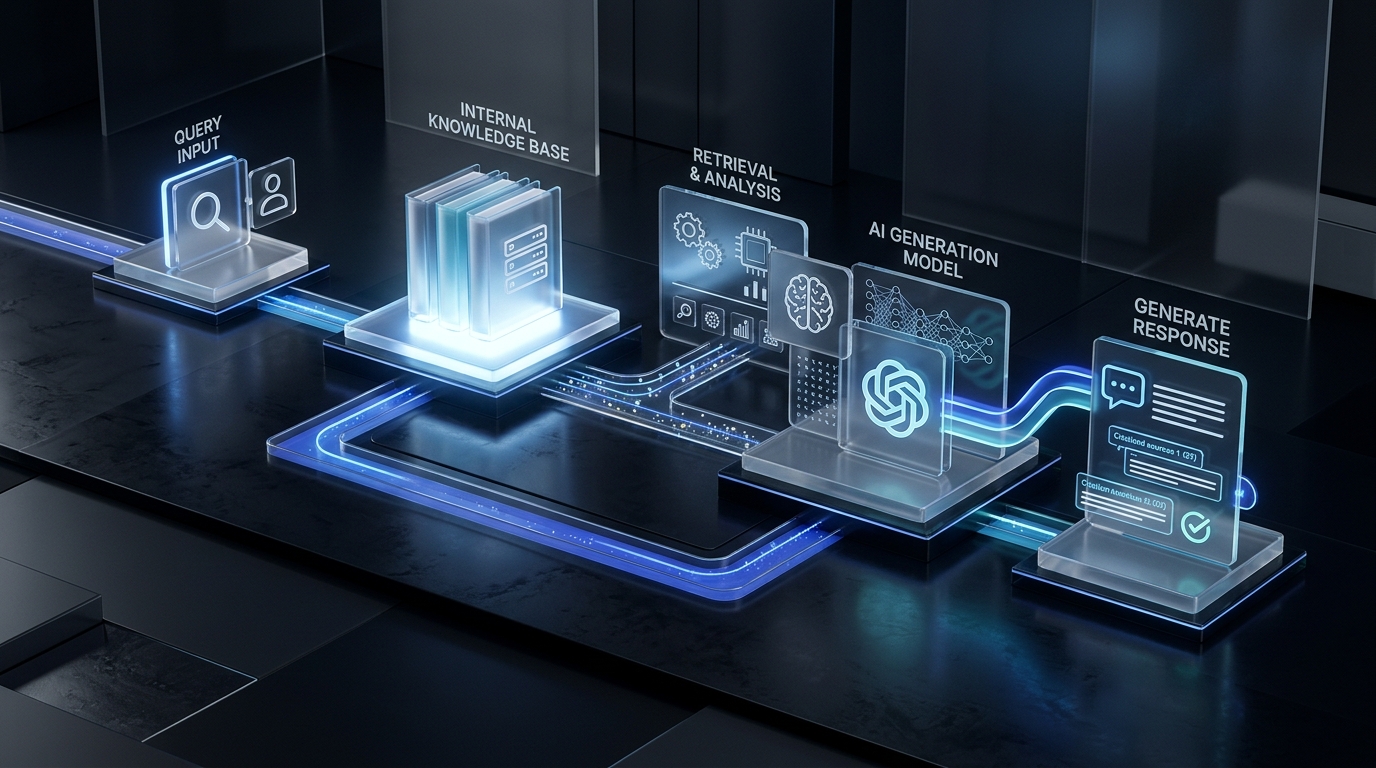
Reliable systems therefore use the principle of the quality-assured knowledge base. The AI reads exclusively from approved help articles, PDFs and internal documents. If the request cannot be answered unambiguously from these sources, the system does not give a speculative answer but passes the question on.
A practical guide for the knowledge base: the specialist literature on knowledge management recommends a central, curated knowledge base as a single source of truth, in which all content is up to date, checked and clearly versioned, in which responsibility for maintenance and quality is clearly assigned, and in which knowledge is not maintained twice8. Outdated documents have to be removed consistently, because a language model cannot judge which of two parallel versions is still valid. Transparent source citations with every answer make sure that customers and service staff can trace at any time what a statement is based on.
The handover moment: from bot to human
Working AI support is defined above all by how it deals with uncertainty. When the system cannot answer a question with absolute certainty, the handover to the human team has to be seamless and without loss of data.
Modern support setups use a shared inbox for this. When the AI recognises its own limits, it passes the conversation so far on to the service team. Instead of staff having to start from scratch, the AI already prepares a suitable draft reply in the background, including the source citation.
- 01Automatic detection: the AI identifies complex concerns or uncertainties in the data basis.
- 02Seamless transfer: the case is handed over to the shared inbox together with the chat history so far.
- 03Draft generation: the AI system proposes a draft reply based on the internal documents.
- 04Human review: a team member checks the draft, adjusts it if needed and sends the answer.
This hybrid approach combines the best of both worlds: speed on standard questions and human expertise on demanding problems. The team keeps full control over sensitive customer contacts.
Practical implementation: starting in small steps
Introducing AI automation requires neither months of IT projects nor complex system migrations. The most pragmatic route is a step-by-step start with clearly delimited use cases. Teams should begin with the most frequently asked questions and extend the automation bit by bit.
One example of this pragmatic approach is the ComLayer platform from CITO GmbH in Hamburg. The system relies on European infrastructure with EU hosting and full compliance with the GDPR. With flexible pricing models, from the free basic version through the Pro plan at €49 per month to scalable setups, the automation can be tested without risk.
The technical embedding usually comes down to a few steps: a short HTML snippet in the web widget, adding the existing documents and concluding a data processing agreement. This keeps the administrative effort minimal, while compliance with current privacy standards is ensured.
The key to success lies in step-by-step validation. Draft replies are first checked internally, before safe categories are released for the automatic answer. That way the degree of automation grows organically and without risk to customer satisfaction.
Frequently asked questions
Which requests can AI fully resolve in customer service in 2026?
AI agents reliably handle Tier 1 requests in B2B SaaS (such as feature explanations and invoice questions) as well as standard processes in e-commerce. Studies show that on clearly defined standard requests in retail, resolution rates of up to 70 per cent are reached, provided the internal knowledge base is well maintained.
How many businesses already use automation in support?
The use of automation technology has arrived in the mainstream. According to Bitkom, 88 per cent of the businesses that use AI at all use it in customer contact. The focus is shifting away from isolated chatbots towards systems that are integrated into the workflow.
Why do some AI projects in customer service fail?
The most common mistake is the missing boundary. If an AI receives no concrete specifications from internal manuals, it tends to guess. On complex technical problems, pure automation fails. Studies show that only about 12 per cent of highly complex orders are processed completely autonomously.
How do you prevent customers from being frustrated by bots?
The solution lies in strict escalation logic. A reliable AI stops its attempt to answer as soon as the knowledge in the internal database is not sufficient. Instead of constructing a wrong answer, the system hands the conversation over to the human team seamlessly.
What is the difference between deflection and a genuine resolution rate?
Deflection, that is case deflection, measures only how many requests the system intercepts without a human stepping in. That also includes customers who give up in exasperation. A genuine resolution rate, by contrast, measures only cases that were completed fully and correctly.
How long does the technical setup of an AI agent take?
With modern platforms the effort is minimal. Often it is enough to insert a short HTML snippet into the website and to feed the AI with existing help articles. The agent draws on this stored knowledge immediately, without a months-long IT project being necessary.