Reducing ticket volume: the levers that measurably work
Find out how to measurably reduce your support ticket volume with a solid knowledge base, AI self-service and removing the causes in the product.
Martin Semmele
Key takeaways
- Without AI, most organisations sit at a deflection rate of 20 to 30 per cent.
- AI-supported self-service in the context of use raises the resolution rate considerably compared with a classic search.
- With AI agents on a well-maintained knowledge base, deflection rates of 40 to 60 per cent are realistic.
- Without removing the causes in the product, the deflection rate stagnates, because only symptoms are treated.
The maths behind the ticket load
In many support teams, ticket volume grows in step with the number of active users. The problem: support teams cannot grow at the same pace as the customer base. When the product scales, the staff costs for manual support rise linearly while the margin falls. One way out is systematic ticket deflection.
The ticket deflection rate is the most central metric in modern customer service. It measures the percentage of customer requests that are resolved without a support agent stepping in. The calculation is simple: requests resolved through self-service, divided by the total number of help attempts, multiplied by 100.
| Support channel | Typical deflection rate | What drives the performance |
|---|---|---|
| Without documentation / email only | 0% | Every request needs a manual answer |
| Classic knowledge base (without AI) | Median 18%, range 5 to 35% | Relies purely on the user searching manually |
| AI-supported self-service | 40 to 60% | Understands intent and answers directly |
Without targeted automation, most organisations reach a deflection rate of 20 to 30 per cent2. That means the large majority of requests end up with human agents. Reducing that load takes more than isolated fixes. It takes four structured levers that work at different levels.
Lever 1: deflection through the knowledge base
A well-structured knowledge base is the foundation of every deflection strategy. Many Help Centres fail not because content is missing, but because it cannot be found and is written in language nobody understands. In a support situation, users do not search for the company's internal terms but for concrete symptoms and problems.
An effective help article answers exactly one question, without distraction. The text has to be precise. Instead of internal product names, the headings and paragraphs need the everyday words of the target group.
- Clear structure: one topic per article with an unambiguous heading.
- User-centred language: replace jargon with the terms customers actually search for.
- Constant updating: outdated articles produce wrong answers and follow-up tickets.
- Basis for AI systems: clean documentation serves as a structured data source for automatic answers.
Well-maintained documentation reaches a deflection rate of around 18 per cent on the industry average1. At the same time it forms the foundation for advanced levels of automation: without a correct knowledge base, neither a support agent nor an AI system can deliver precise answers.
Lever 2: proactive self-service right inside the widget
The best help article is no use if the user has to leave the application to look for it. If customers first have to open Google or an external Help Centre, there is a break between channels. The consequence: many users skip the search and write a ticket straight away.
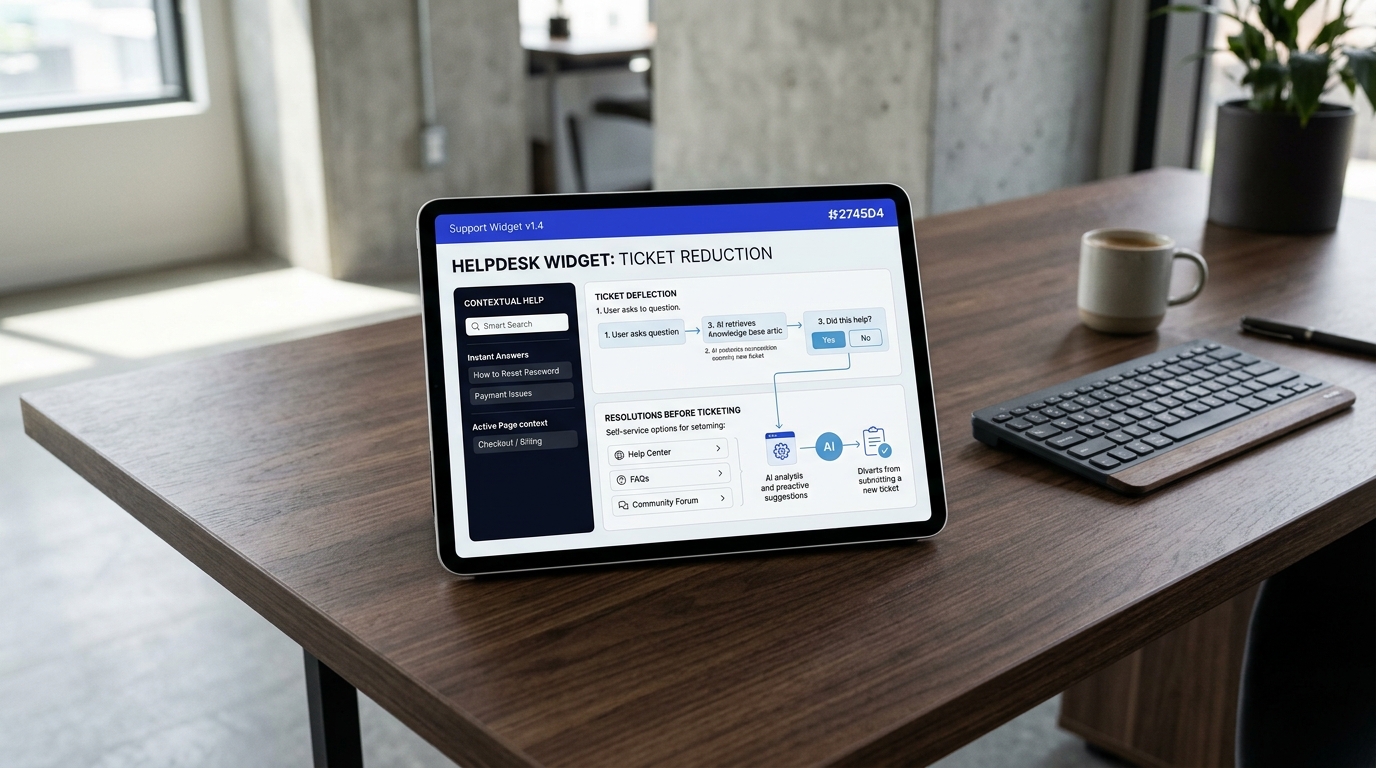
Proactive self-service places the relevant help content exactly where the problem occurs. A support widget built into the product offers suggestions that fit the current page or feature.
Integrating help content directly into the widget consistently avoids breaks between channels. The effect is measurable: passive self-service in a separate Help Centre quickly runs into a ceiling, because users have to search first and go straight to a human when the search fails, while teams with well-implemented contextual self-service report deflection rates of 40 to 60 per cent3. It is also decisive to measure the satisfaction of the contacts handled automatically, otherwise deflection is only work that has been moved.
Lever 3: automating recurring requests
A large part of the daily ticket volume consists of recurring routine questions. Questions about passwords, invoices or standard features tie up valuable working time. If these requests are handled manually, customers wait unnecessarily.
A modern AI agent uses retrieval-augmented generation (RAG) to answer requests from the internal knowledge base. Unlike older rule-based chatbots, an AI agent understands the intent behind the question. Transparency is the precondition for trust: every answer has to be based on the verified knowledge base and carry transparent source citations.
| Property | Rule-based chatbot | AI agent with RAG |
|---|---|---|
| Answer quality | Rigid, following predefined patterns | Generated dynamically from the knowledge base |
| Understanding | Recognises exact keywords only | Recognises intent and context |
| Deflection rate | Typically around 11% | Reaches 40 to 60% |
| Source citation | Not available | Direct link to the help article |
Combining an AI agent with the knowledge base realistically lifts the deflection rate to 40 to 60 per cent4. That noticeably takes load off the support team. What matters is that the system invents no answers: if the question cannot be answered unambiguously from the documents at hand, there is no speculation.
The fallback: a seamless handover to a human
No automation system can or should resolve 100 per cent of all requests. Complex special cases, individual account problems or angry customers call for a human touch. Trying to prevent these cases artificially makes customer satisfaction drop sharply.
Radical transparency is the key here. If the system finds no clear answer in the knowledge sources, it has to admit that openly and pass the request to a support agent immediately. Forcing the customer to stay with the chatbot destroys trust.
- 01Detecting gaps in the knowledge: the AI identifies questions it cannot answer, without hallucinating.
- 02Handover with context: the conversation so far is passed to support in full.
- 03Bundling in one place: requests from the widget, email and chat come together in a shared inbox.
- 04Feedback loop: unanswered questions show which help articles are missing from the documentation.
All message channels, whether live chat, email or a form, should be bundled in one central inbox. When the AI system reaches the limits of its knowledge, a human takes over without losing information. The support team sees exactly what has been discussed so far and can help specifically, right away.
Lever 4: removing the causes in the product itself
Automation and documentation treat symptoms. Anyone who wants to reduce ticket volume for good has to remove the causes in the product. Every ticket is basically a sign of something not understood, or of an obstacle in the user journey.
When requests about how a button works or how verification runs pile up, the problem is not missing documentation but the interface. Without consistently removing the causes in the product, the deflection rate stays where it is in practice, because the same questions keep arising.
- Ticket clustering: regular analysis of the most frequent ticket categories in the support team.
- UX optimisation: adjust confusing workflows and interfaces directly.
- Proactive notices: show in-app notices at known bottlenecks before an error occurs.
- Product feedback loop: feed support findings straight into the development roadmap.
By analysing ticket clusters, the product team sees where the stumbling blocks are. If the confusion is fixed at source, the best kind of deflection happens: the ticket is never even thought of.
Measuring and implementing: the next steps
Reducing the ticket load is not a one-off project but a continuous process. To steer the outcome, support leads have to watch the right metrics. Besides the plain deflection rate, the real resolution rate (self-service resolution rate) is decisive.
A successful strategy also takes follow-up questions within 48 hours into account. If requests are marked as resolved but the customer comes back shortly afterwards, this is a sham deflection: the real deflection rate only emerges once the 48-hour follow-ups are subtracted from the self-service resolutions5. The goal is to lower the real cost per ticket while keeping the quality.
| Step | Measure | Target KPI |
|---|---|---|
| 1. Taking stock | Structure the knowledge base and remove outdated articles | Knowledge base findability |
| 2. In-app self-service | Embed the Help Centre and support widget directly in the product | Use of the help articles |
| 3. AI automation | Switch on an AI agent for recurring requests on your own knowledge base | 40 to 60% deflection rate |
| 4. Root cause analysis | Analyse ticket clusters and hand the feedback to the product team | Reduction of the total volume |
For European teams, conditions such as privacy and compliance with the GDPR also play a central role when choosing tools. A modern support platform combines widget, Help Centre, AI agents and shared inbox in one system environment, so that knowledge is used directly. With transparent plans such as the Pro plan from €49 per month, AI support can be implemented flexibly, without complex enterprise projects.
Frequently asked questions
What is a good ticket deflection rate?
Without AI, most teams sit at 20 to 30 per cent; a classic knowledge base on its own delivers around 18 per cent at the median. With an AI agent on a well-maintained knowledge base, 40 to 60 per cent are realistic.
How does self-service help to reduce ticket volume?
Good self-service delivers answers exactly where the problem occurs, for example through a widget. AI-supported self-service reacts actively to the specific question, whereas a classic search assumes that users find the right article themselves. That noticeably raises the resolution rate.
Does automation replace the human support team?
No. An AI agent takes over recurring questions that have clear answers in the knowledge base. That takes load off the team. For complex requests, or where knowledge is missing, there is always a fallback to the support agents.
What happens if the AI cannot answer a question?
A reliable AI agent does not guess. If the information is missing from the stored sources, the AI stops and hands the conversation, together with the context so far, seamlessly to the support team's shared inbox.
Why is removing the causes in the product so important?
When users fail at the same point, the same ticket is created again and again. If these gaps are not fixed in the product, the ticket deflection rate stagnates, because automation only fights the symptoms.